
(Published first in Finnish in the Ympäristöt catalogue 2026 of the Finnish Association for Environmental Journalists)
The challenging theme of the Environmental Journalism Day 2025 was renewable energy and the green transition with all its impacts. There is a lot of new, old and incorrect information circulating on the topic.
The main message for me was that the nimby policy and opposition to everything will not help when the situation has already become so critical. Low-emission renewable energy must be obtained quickly and in large quantities, and this will not be possible without doing any harm. Minimizing harm through science, careful planning and high-quality environmental impact assessments is essential.
The first speaker was Italian Ariel Brunner, BirdLife’s Regional Director for the EU and Central Asia. Through a remote connection, he explained how the biodiversity crisis and climate change are linked and cannot be solved separately. Science clearly shows the seriousness of both crises.
“The future is renewable energy. Wind and solar are its main sources, and they are already in use and can be scaled up quickly. Nuclear power is too slow and expensive to be a solution,” said Brunner, using Olkiluoto 3 in Finland as an example.
Renewable energy from a bird’s eye view
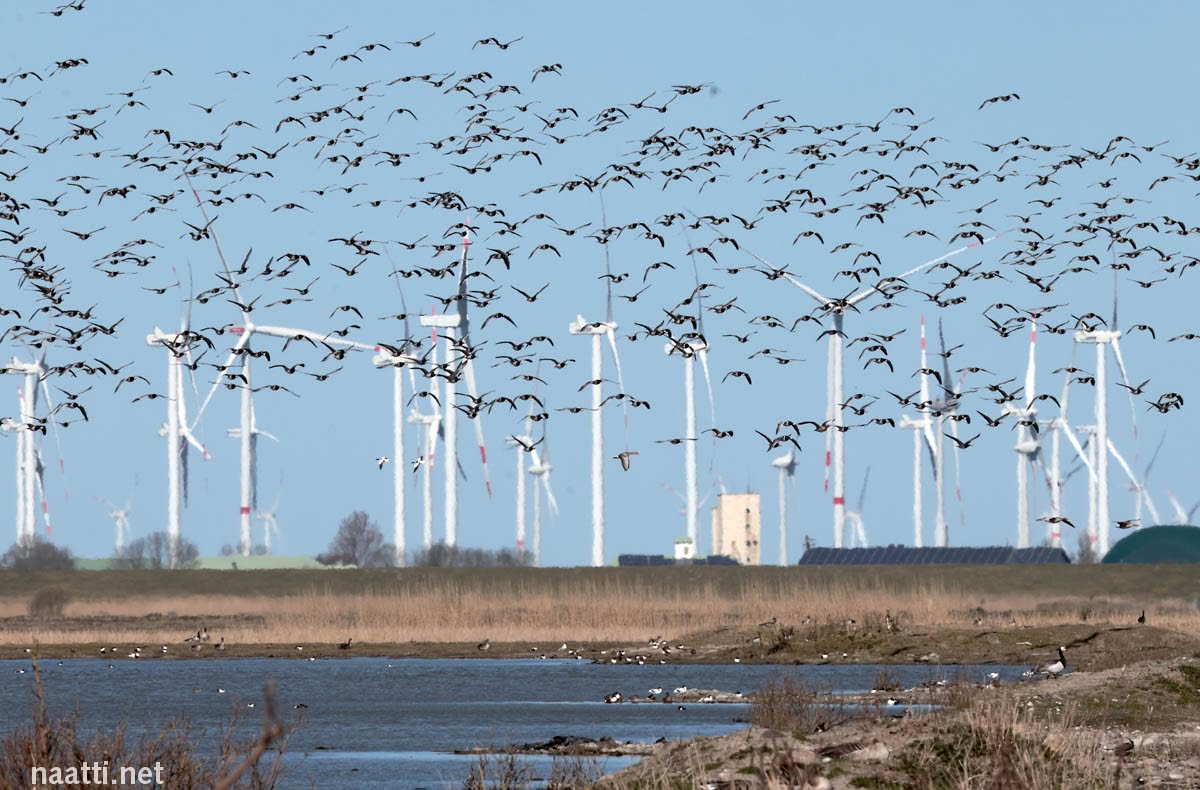
This image of the Wadden Sea National Park, flattened by a telephoto lens, could as well be from other places where bird populations have learned to coexist with wind farms without suffering significant harm. Nevertheless, wind power represents yet another factor contributing to the shrinking of bird habitats, a process primarily driven by agriculture, fishing, forestry, etc.
So what impacts does renewable energy in large quantities have on nature? According to a meme that many people are familiar with, cats are the biggest killers of birds and wind turbines are of negligible importance.
– However, we are comparing apples and oranges here: cats mostly kill familiar garden birds, but not eagles or cranes that collide with the wings of wind turbines.
– Of course, a large number of birds notice wind turbines and avoid them, but then they may have to look for new habitats and extend their flight distances. And then they are exposed to other dangers, such as tall buildings or power lines.
Brunner presented a map of the numerous wind farms planned for the northern seas. When, in addition to these, cables, merchant and fishing vessels and cruise ships pass through the seas, there is even less space left for birds.
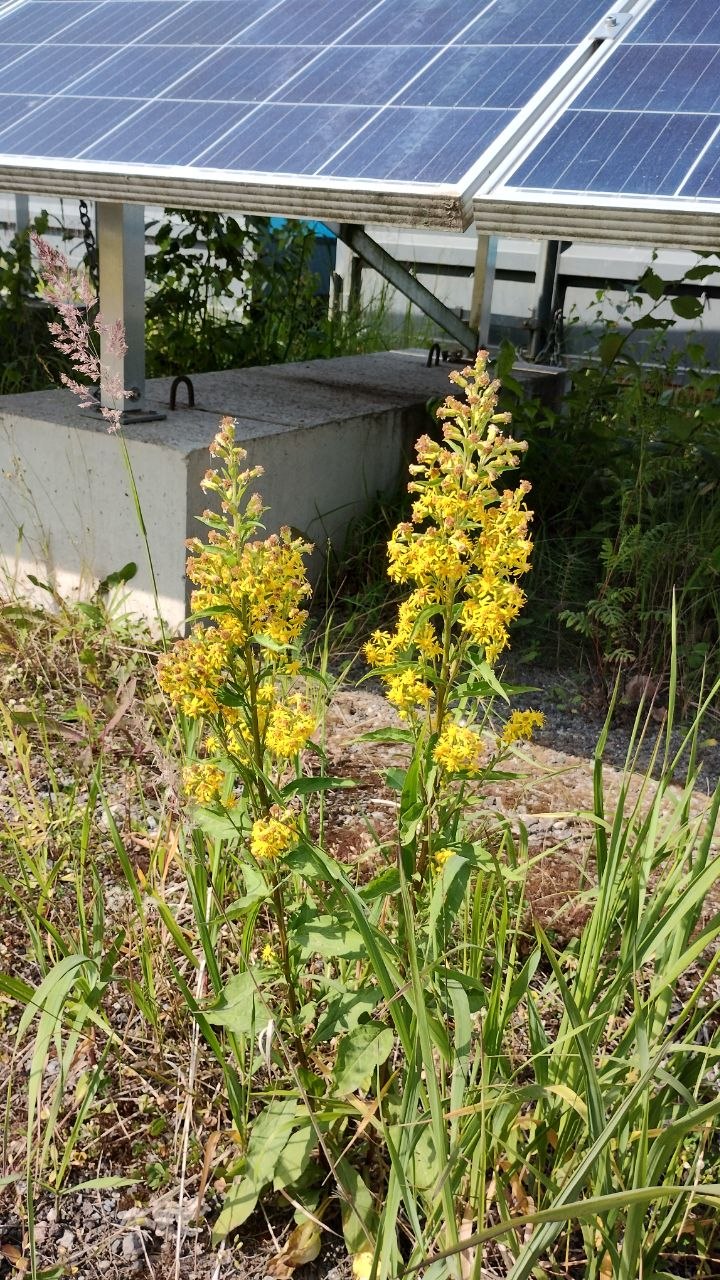
Blooming vegetation in the solar panel field in Kuopio.
– The situation with solar power plants is simpler: the main question is what kind of area they will be built on, and also whether new high-voltage lines will be needed for them.
Brunner also warned about the use of bioenergy, mainly wood energy in Finland, and stated that with current logging rates, it is more part of the problem than the solution.
So what can we do?
If wind and solar power are the main solutions for renewable energy, what can be done to adapt them to nature and prevent problems?
– First, we need to reduce other pressures on biodiversity. For example, we need to leave more fish for seabirds to catch and establish more marine protected areas. This will result in more seabirds, and the healthier the population, the better it will cope with excess mortality or habitat loss.
– In energy issues, the most important thing is to follow the hierarchy of mitigation. It starts with a location that has a neutral or minimal impact on nature. Then, other means must be used to avoid and reduce negative impacts. If there are no alternatives, as a last resort, the lost habitat is replaced by restoring and protecting it somewhere else.
– The location of wind and solar power plants must be based on strategic planning and researched information in order to determine their own areas for energy production and biodiversity – in some cases, these are even suitable for the same area.
Brunner said that numerous sensitivity surveys have been carried out in different countries, for example the Avistep model, which show the best and worst locations for bird life. According to him, when information about wind potential and existing power lines is compared with the sensitivity analysis, good planning can be achieved.
– Even after that, it is important to conduct a careful environmental impact assessment for each project. If the EIA is not done meticulously, we will end up with bad projects that can cause a lot of damage and lead to conflicts.
– There are already many technical ways to prevent bird collisions with wind turbines, and interesting new ones are being developed, for example using artificial intelligence. We also already know how to prevent the dangers of power lines to birds, it is just a matter of the political will to do it.
Brunner sees good governance, transparency and the use of science as the starting point for good planning. He criticized the Finnish Ministry of the Environment for refusing to publish a report on the harm of wind turbines to golden eagles in 2024. “The role of the media is to expose such blackouts,” said Brunner.
“It is easier to locate solar power plants. They have tremendous potential to increase biodiversity, especially if care is taken to ensure that diverse natural vegetation grows underneath. Even endangered and rare species can live in the area of solar and wind turbines. You can also cultivate crops under solar power plants – they can increase productivity, especially in southern Europe, where too much sunlight is a problem.
Brunner’s recommendations for journalists
– Wind farms don’t kill all the birds, but they do kill some birds, and the main problem lies elsewhere. The reality is complex, and your role is to make that reality accessible to people. This means simplifying the problems, but not ignoring them.
– The world, especially social media, is full of propaganda, much of which comes from the fossil fuel industry.
Brunner finally summarized his recommendations for journalists as follows:
– Don’t make careless generalizations
– Check reliable sources of information and ask experts – don’t copy propaganda
– Demand that authorities and politicians be held accountable for their decisions
– Defend civil society and democracy.
Text and photos: Auli Kilpeläinen


